
Introduction
Finding the right NDIS house cleaners is an important decision for participants who need assistance maintaining a clean, comfortable, and well-organised home. A suitable cleaning service can provide practical household support while taking into account the participant’s individual preferences, routines, and living environment.
Keeping a home clean involves many regular tasks, from vacuuming and mopping to maintaining kitchens, bathrooms, bedrooms, and shared living areas. For someone who finds these activities difficult to manage independently, professional cleaning support can make everyday home maintenance more manageable.
However, choosing NDIS house cleaners is not simply about finding someone who can clean a property. Participants and their families may also want a provider that communicates clearly, respects personal spaces, arrives as arranged, and provides a service suited to individual circumstances.
CQ Cleaningplus provides professional cleaning solutions across its service areas, with a focus on reliability, quality workmanship, clear communication, and tailored cleaning support. Its wider service offering includes domestic cleaning, NDIS cleaning support, aged care cleaning, construction cleaning, commercial cleaning, and property maintenance.
This guide explains what to consider when looking for NDIS house cleaners, what household cleaning may involve, and how to choose a service that provides a professional and respectful experience.
What Are NDIS House Cleaners?
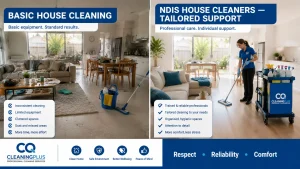
NDIS house cleaners are professional cleaners who provide household cleaning assistance to participants who require support with maintaining their living environment.
The cleaning itself can involve many familiar household tasks, but the way the service is delivered is particularly important. Participants may have different routines, preferences, priorities, and requirements, so a suitable cleaning arrangement should be practical and adaptable.
Depending on the agreed service, household cleaning may include:
- Vacuuming floors and carpets
- Mopping hard floors
- Dusting surfaces
- Cleaning kitchens
- Cleaning bathrooms
- Maintaining bedrooms
- Cleaning living areas
- Removing general household waste
- Maintaining commonly used spaces
The exact tasks should be discussed with the cleaning provider before services begin so that both sides understand what is expected.
Why Professional NDIS House Cleaners Can Be Valuable
Maintaining a home can require considerable physical effort and regular attention. Cleaning tasks can become particularly challenging when a participant has difficulty with bending, lifting, reaching, standing for extended periods, or completing repetitive household activities.
Professional cleaning support can help reduce some of these practical demands.
Support With Everyday Household Tasks
Regular cleaning assistance can help keep essential areas of the home maintained without requiring the participant to complete every task themselves.
A More Comfortable Living Environment
Clean floors, surfaces, bathrooms, kitchens, and living areas can contribute to a more pleasant home environment.
Consistent Household Maintenance
A regular cleaning arrangement can provide structure and consistency, helping prevent cleaning tasks from accumulating.
Individualised Service
A good provider takes the participant’s preferences into account rather than assuming every household requires the same cleaning routine.
What Can NDIS House Cleaners Do?
The cleaning requirements of each participant can vary considerably. Some people may need support with general household maintenance, while others may require attention to particular areas of the home.
A typical service may cover several categories.
| Cleaning Area | Possible Tasks | Main Purpose |
|---|---|---|
| Living Areas | Dusting, vacuuming, surface cleaning | Maintain comfortable shared spaces |
| Kitchen | Benches, sink, surfaces, floors | Maintain a clean food-preparation area |
| Bathroom | Toilet, shower, vanity, mirrors | Maintain hygiene and presentation |
| Bedrooms | Dusting, vacuuming, surfaces | Maintain comfortable private spaces |
| Hallways | Vacuuming, mopping, general cleaning | Keep frequently used areas maintained |
| Common Areas | Surface and floor cleaning | Support overall household upkeep |
These are examples rather than a fixed checklist. The appropriate service should be discussed with the provider based on the participant’s requirements.
NDIS House Cleaners vs Regular House Cleaners
At first glance, NDIS cleaning and standard domestic cleaning can appear very similar because both involve household cleaning.
The important difference is the service approach.
| Standard House Cleaning | NDIS House Cleaning Support |
|---|---|
| Primarily focused on household cleaning | Cleaning is provided within an individual support context |
| Often follows a general checklist | Tasks can be discussed around participant requirements |
| Usually focused on property presentation | Can place greater emphasis on participant preferences and routines |
| Standard customer relationship | Requires respectful interaction within a participant’s home |
| General residential service | May form part of broader support arrangements |
This does not mean every NDIS cleaning service is completely different from domestic cleaning. Many of the actual cleaning tasks may overlap. The distinction is often in the way the service is planned and delivered.
What Should You Look For In NDIS House Cleaners?
Choosing a provider requires consideration beyond the advertised cleaning service.
Several qualities can help create a better experience.
Reliability
Cleaning support is most useful when the service is dependable. Participants should be able to understand when cleaning is scheduled and what they can expect from each visit.
A reliable provider should communicate clearly about appointments and any changes that may affect the service.
Respect
Cleaners work inside people’s homes, which makes respect particularly important.
Professional cleaners should treat personal belongings, private areas, and household routines with consideration.
Communication
Good communication helps prevent misunderstandings.
Before services begin, it can be useful to discuss:
- Preferred cleaning areas
- Frequency of visits
- Specific household priorities
- Access arrangements
- Areas requiring special attention
- Any relevant preferences
Flexibility
Household circumstances can change. A suitable provider should be able to communicate about changing requirements and determine whether adjustments can be accommodated.
Attention To Detail
A professional cleaner should not simply move through a checklist without considering the actual condition of the home.
Attention to detail can make a significant difference to the final result.
How To Find The Right NDIS House Cleaners
Searching for NDIS house cleaners can produce many options. Comparing providers carefully can make the selection process easier.
Start by identifying the type of assistance required.
For example, consider whether you need:
- Ongoing general cleaning
- Kitchen and bathroom maintenance
- Floor cleaning
- Whole-home cleaning
- Additional household cleaning support
Once the requirements are clear, you can compare providers based on their service approach.
Step 1: Understand Your Cleaning Requirements
Make a list of the household areas that need regular attention.
This does not have to be complicated. A simple list of priorities can help the cleaning provider understand the expected service.
Step 2: Discuss The Service
Ask the provider what cleaning tasks they offer and how they normally organise services.
Step 3: Discuss Your Preferences
Explain any preferences relating to timing, cleaning priorities, household areas, or communication.
Step 4: Confirm The Arrangement
Before the first service, make sure the agreed cleaning tasks, schedule, and expectations are clear.
Step 5: Review The Service
After the first few visits, consider whether the service is meeting the agreed requirements.
Open communication makes it easier to address any concerns or changes.
How Often Should NDIS House Cleaners Visit?
There is no universal cleaning frequency that suits every participant.
The appropriate schedule depends on factors such as:
- Size of the home
- Number of occupants
- Amount of household activity
- Cleaning requirements
- Areas requiring regular maintenance
- Individual circumstances
For some homes, regular weekly cleaning may be suitable. Other households may require a different arrangement.
| Cleaning Frequency | Suitable Consideration |
|---|---|
| More frequent support | Homes requiring regular attention across high-use areas |
| Weekly support | Ongoing general household maintenance |
| Fortnightly support | Homes with lower or moderate cleaning requirements |
| Occasional support | Specific cleaning needs or temporary assistance |
These are general scheduling examples rather than fixed recommendations. The right frequency should be determined according to the participant’s circumstances and agreed service requirements.
Creating A Practical Cleaning Checklist
A cleaning checklist can help both the participant and cleaner understand priorities.
For example, a household may divide cleaning into three levels.
Essential Areas
These are spaces that should receive regular attention.
- Kitchen
- Bathroom
- Main living area
- Frequently used floors
Secondary Areas
These areas may require attention depending on the schedule.
- Bedrooms
- Hallways
- Dining areas
- Additional surfaces
Occasional Areas
These may require less frequent attention.
- Detailed cupboard cleaning
- Less-used rooms
- Additional surface detailing
- Specific property maintenance tasks
This approach can make cleaning arrangements more organised without creating an unnecessarily complicated routine.
Personalised Cleaning Makes A Difference
Every participant’s home is different.
A cleaner may work in a compact apartment one day and a larger family home another day. The participant may also have particular preferences regarding which areas receive priority.
For example, one participant may prioritise kitchen and bathroom cleaning, while another may place greater importance on maintaining clear living areas and regularly cleaned floors.
A personalised approach helps ensure that available cleaning time is directed toward the areas that matter most.
Respect And Privacy When Cleaning A Participant’s Home
Professionalism is especially important when cleaning someone’s personal home.
NDIS house cleaners may work around personal belongings, photographs, furniture, medication areas, mobility equipment, and other items that form part of a participant’s everyday environment.
Cleaners should therefore work carefully and respectfully.
Important principles include:
- Treat personal belongings with care
- Follow agreed instructions
- Respect private areas
- Communicate before making significant changes
- Avoid unnecessary disruption
- Maintain professional boundaries
A respectful approach helps build trust between the participant and cleaning provider.
Cleaning For Accessibility And Ease Of Movement
Home cleaning can also involve maintaining clear and practical living areas.
Keeping floors and frequently used pathways free from unnecessary clutter can make spaces easier to navigate.
Cleaning support may therefore contribute to maintaining:
- Clear walkways
- Accessible common areas
- Clean floors
- Organised living spaces
- Comfortable frequently used rooms
The purpose is not to rearrange someone’s home without permission. Instead, cleaning should respect the existing arrangement and focus on maintaining the environment according to the participant’s preferences.
What Makes A Good NDIS Cleaning Experience?
The quality of a cleaning service is not determined by the final appearance alone.
A positive experience can involve several elements.
| Service Element | Positive Experience |
|---|---|
| Communication | Expectations are clearly discussed |
| Scheduling | Visits are organised and dependable |
| Respect | Personal space and belongings are treated carefully |
| Cleaning Quality | Agreed areas receive proper attention |
| Flexibility | Changes can be discussed when circumstances change |
| Professionalism | Staff maintain appropriate workplace behaviour |
These factors work together to create a reliable service relationship.
Questions To Ask NDIS House Cleaners Before Booking
Before choosing a provider, participants or families can ask several practical questions.
What cleaning tasks do you provide?
This helps establish whether the provider can meet the household’s requirements.
Can the cleaning service be tailored?
Ask whether cleaning priorities can be adjusted according to individual needs.
How is the cleaning schedule organised?
Understanding frequency and appointment arrangements can prevent confusion.
How do you communicate with participants?
Clear communication is important throughout the service relationship.
Do you provide ongoing cleaning?
If regular assistance is required, confirm whether the provider can accommodate an ongoing arrangement.
What happens if requirements change?
A provider should be able to explain how changes to the cleaning arrangement are handled.
Why Choose CQ Cleaningplus?
CQ Cleaningplus provides professional cleaning solutions with a focus on reliable service, quality workmanship, clear communication, and tailored cleaning arrangements. Its service offering includes domestic cleaning, NDIS cleaning support, aged care cleaning, commercial cleaning, construction cleaning, and property maintenance.
For NDIS-related cleaning support, the focus is on helping maintain comfortable and well-presented home environments while respecting individual requirements.
CQ Cleaningplus’s broader service approach emphasises:
- Reliable service
- Quality workmanship
- Attention to detail
- Flexible cleaning solutions
- Clear communication
- Long-term client relationships
These principles can help create a professional and dependable cleaning experience.
Frequently Asked Questions
What are NDIS house cleaners?
NDIS house cleaners are professional cleaners who provide household cleaning assistance to eligible participants according to their individual support arrangements and requirements.
What cleaning tasks can NDIS house cleaners provide?
Depending on the agreed service, tasks may include vacuuming, mopping, dusting, kitchen cleaning, bathroom cleaning, bedroom cleaning, and general household maintenance.
Are NDIS house cleaners different from domestic cleaners?
The cleaning tasks may be similar, but NDIS cleaning support generally requires greater consideration of participant needs, preferences, routines, and the way services are delivered within the home.
How often should NDIS house cleaners come?
Cleaning frequency depends on the participant’s circumstances, property, cleaning requirements, and agreed arrangements. There is no single schedule that suits every household.
Can NDIS cleaning support be personalised?
Cleaning requirements can often be discussed and organised around individual priorities. Participants should communicate their requirements with the provider before services begin.
What should I ask before choosing an NDIS house cleaner?
Ask about available services, scheduling, communication, cleaning priorities, flexibility, and how the provider works with participants in their homes.
Does CQ Cleaningplus provide NDIS cleaning support?
CQ Cleaningplus lists NDIS cleaning support among its professional cleaning services, alongside domestic, commercial, construction, aged care, and property maintenance solutions.
Final Thoughts
Choosing the right NDIS house cleaners is about finding a service that combines practical cleaning ability with reliability, respect, communication, and an understanding of individual requirements.
A clean home can make everyday living more comfortable and manageable, while consistent household support can reduce the pressure associated with maintaining essential living spaces.
Before choosing a provider, consider the cleaning tasks you need, the preferred schedule, your household priorities, and the level of communication and flexibility you expect.
CQ Cleaningplus focuses on dependable cleaning solutions and tailored service across its cleaning and property maintenance offering. For participants and families considering professional household cleaning support, discussing individual requirements with the provider is the best way to determine whether the service is a suitable fit.